


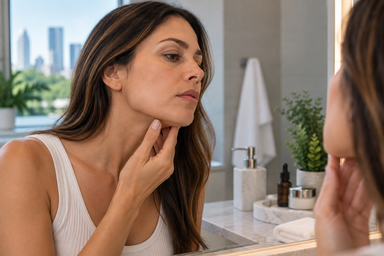
If you have ever tilted your chin up in the mirror, wondering where your jawline went, you are not alone. It is one of the most common things clients bring up during a consultation, and it rarely has a single cause. Sometimes it is genetics. Sometimes it is a few extra pounds. Sometimes it is simply time doing what time does. Whatever the reason, the good news is that jawline contour does not have to mean surgery. At Bougie Aesthetics in Fort Worth, we use a combination of dermal fillers, biostimulators, and collagen-building treatments to bring structure back to the lower face, without anyone being able to point to what changed. They just notice you look sharper, more rested, more you.
This guide walks through why jawlines soften in the first place, what your non-surgical options actually look like, and how to figure out which approach fits your face. Updated this September 2026 to reflect the treatments we are currently recommending most often for jawline definition here in Fort Worth and across the greater DFW area.
What Causes a Soft or Undefined Jawline?
Before anyone reaches for a treatment, it helps to understand what is actually happening underneath the skin. A jawline is really a story about bone structure, fat distribution, and skin quality all working together (or not).
Genetics, Weight, and Age All Play a Role
Some people are simply born with a less angular bone structure along the mandible. A rounder jaw or a naturally recessed chin can make the jawline look softer even at a healthy weight and a young age. That is not a flaw, it is just anatomy, and it is one of the most common reasons clients come in asking about jawline contour in their twenties and thirties.
Weight is another factor. Fat tends to accumulate under the chin and along the jaw before it shows up elsewhere, which is why even a modest weight gain can blur definition that used to be there.
Then there is age. As we get older, we lose collagen and fat volume in the face, particularly in the cheeks and along the jaw. That volume has to go somewhere, and often it settles lower on the face, contributing to jowling and a jawline that looks less crisp than it did a decade ago. Bone remodeling plays a quiet role here too, since the jawbone itself can lose density over time.
How Submental Fullness Affects Jawline Definition
Here is something that surprises a lot of clients: you do not have to be overweight to have submental fullness, which is the clinical term for fullness under the chin, often called a double chin. Genetics can predispose someone to storing fat in that specific area regardless of their overall body composition. And because that pocket of fat sits right where the jaw meets the neck, it can visually erase the jawline even when the rest of the face looks lean and defined.
This is exactly why jawline contour conversations often start with a conversation about the chin and neck, not just the jaw itself. If submental fullness is part of the picture, addressing it is often the missing piece.
What Are the Non-Surgical Ways to Contour a Jawline?
Once we understand what is driving the softness, we can match it to the right tool. At Bougie Aesthetics, that usually means one of three approaches, sometimes used together.
How Dermal Fillers Create Jawline Structure
Dermal fillers are often the first stop for jawline contour because they work immediately. Hyaluronic acid and other specialty fillers are placed carefully along the jawline and chin to build out structure, restore lost volume, and sharpen the angle where the jaw meets the neck. Because the results show up right away and downtime is minimal, most people can see a difference the same day they come in, then go about their week with little more than some temporary swelling or tenderness at the injection sites. Depending on the specific filler and the area treated, results typically last anywhere from six to eighteen months.
Fillers tend to work best for people who want a defined, chiseled look fairly quickly, or who are looking to correct a specific area like a weak chin or an asymmetry along the jaw.
When Radiesse Makes More Sense Than an HA Filler
Radiesse is a different kind of product entirely. It is a biostimulator, meaning it does not just add volume, it also encourages your body to produce its own collagen and elastin over time. The calcium hydroxylapatite microspheres in Radiesse provide immediate structure the moment it is injected, and then continue working underneath the skin for months afterward.
For jawline, chin, and cheek contouring, this dual action makes Radiesse a strong option for people who want both an instant improvement and a longer-term rebuilding effect. Results generally last around twelve to eighteen months. One important note: Radiesse is not reversible the way hyaluronic acid fillers are, so it really does call for an experienced injector who understands facial anatomy and can place it with precision. This is one of the reasons our injectable specialist Missy Enos, who has spent over a decade in aesthetics, is often the one guiding these treatment plans.
How Sculptra Builds a Jawline Gradually Over Time
Sculptra takes a slower, more patient approach. Rather than delivering instant volume, it works as a pure collagen stimulator, gradually rebuilding structure in the deeper fat compartments of the lower face over weeks and months. At Bougie Aesthetics, we typically use what we call a Multipoint Approach, placing Sculptra strategically across the jawline and surrounding areas to encourage a natural, gradual return of structure rather than a single dramatic change.
Because it works with your own collagen production, the results tend to look remarkably natural, and they can last up to two years or longer, which makes Sculptra a favorite for clients who are thinking long term rather than looking for an immediate transformation before an event.
How Do You Know Which Jawline Treatment Fits Your Face?
There is no universal answer here, which is exactly why we do not treat jawline contour as a one size fits all service. Someone with a naturally recessed chin and minimal volume loss might do beautifully with a targeted filler. Someone dealing with early volume loss along the jaw and cheeks might benefit more from Radiesse's combination of instant lift and collagen support. And someone who wants a gradual, undetectable improvement over several months, with results that last the longest, might be a better candidate for Sculptra.
If submental fullness is part of what is blurring your jawline, that changes the equation too. Kybella uses deoxycholic acid to permanently destroy fat cells under the chin, and for the right candidate, treating that fullness first can reveal a jawline that was there all along, just hidden.
This is really a conversation, not a checklist. During a consultation at Bougie Aesthetics, we look at your bone structure, your skin quality, how much volume has been lost (if any), and what kind of timeline and look you are hoping for. Our approach has always been about enhancing what is already there rather than creating a dramatically different face. As we like to say, we want people to notice that you look great, not that you had work done.
What Does Recovery and Longevity Look Like?
One of the appeals of non-surgical jawline contour is how little it disrupts your life. Filler and Radiesse appointments typically take under an hour, and while some mild swelling, bruising, or tenderness is normal for a few days afterward, most clients are comfortable returning to normal activities almost immediately. Sculptra has a similarly easy recovery, though because it works gradually, you will not see the full effect until several sessions and a few months have passed.
Longevity varies by treatment. Fillers generally last six to eighteen months, Radiesse tends to run twelve to eighteen months thanks to its collagen-stimulating effect, and Sculptra can hold up for two years or more. None of these are permanent, which is actually a benefit for most people, since facial structure and preferences can shift over the years, and having options that fade gracefully rather than requiring surgical reversal gives you room to adjust as you go.
Can You Combine Treatments for a More Sculpted Jawline?
Often, yes. It is fairly common for a treatment plan to layer approaches, for example using a filler to establish immediate definition along the jaw while Radiesse or Sculptra work in the background to build collagen and extend results over time. If submental fullness is contributing to the lost definition, addressing that with Kybella first can make everything else more effective, since you are working with a cleaner canvas along the jaw and neck.
The right combination really depends on your goals, your anatomy, and how quickly you want to see results. That is exactly the kind of nuance we walk through during a consultation, rather than assuming everyone needs the same protocol.
Frequently Asked Questions About Jawline Contour
Is jawline contour painful? Most clients describe mild discomfort rather than significant pain. We use topical numbing and fine needles or cannulas to keep the experience as comfortable as possible, and any soreness afterward is usually mild and short-lived.
How long does jawline contour treatment take? A typical appointment for filler or Radiesse runs about thirty to sixty minutes. Sculptra sessions are similar in length, though the full jawline contour effect builds over a series of treatments spaced several weeks apart.
Will jawline contour look natural, or will people be able to tell? Natural results are really the whole point. Our team places product carefully and conservatively, layering volume where it is needed rather than overfilling, so the goal is always for people to notice that you look refreshed, not that you had anything done.
Do I need to lose weight before getting jawline contour treatment? Not necessarily. Submental fullness can occur even in people at a healthy weight, and treatments like Kybella or targeted filler placement can address jawline definition independent of overall weight.
How soon will I see results from jawline contour treatment? Filler and Radiesse show visible results almost immediately, with any swelling settling within a week or two. Sculptra builds gradually, with visible improvement typically developing over several weeks to a few months as your own collagen responds.
The Bottom Line on Bringing Your Jawline Back
A soft jawline is not a personal failing, it is biology, and biology can be gently persuaded to cooperate. Whether your Fort Worth lifestyle has you squeezing in a lunchtime appointment on West 7th or planning ahead for a big event across DFW, there is a non-surgical path that fits your face and your schedule. The best next step is simply a real conversation about your anatomy and your goals, which is exactly what happens when you reach out to schedule a consultation with our team. You can also learn more about our full range of injectable and regenerative options on the Bougie Aesthetics homepage before you come in. Your jawline is still there. Let's help it show up again.