



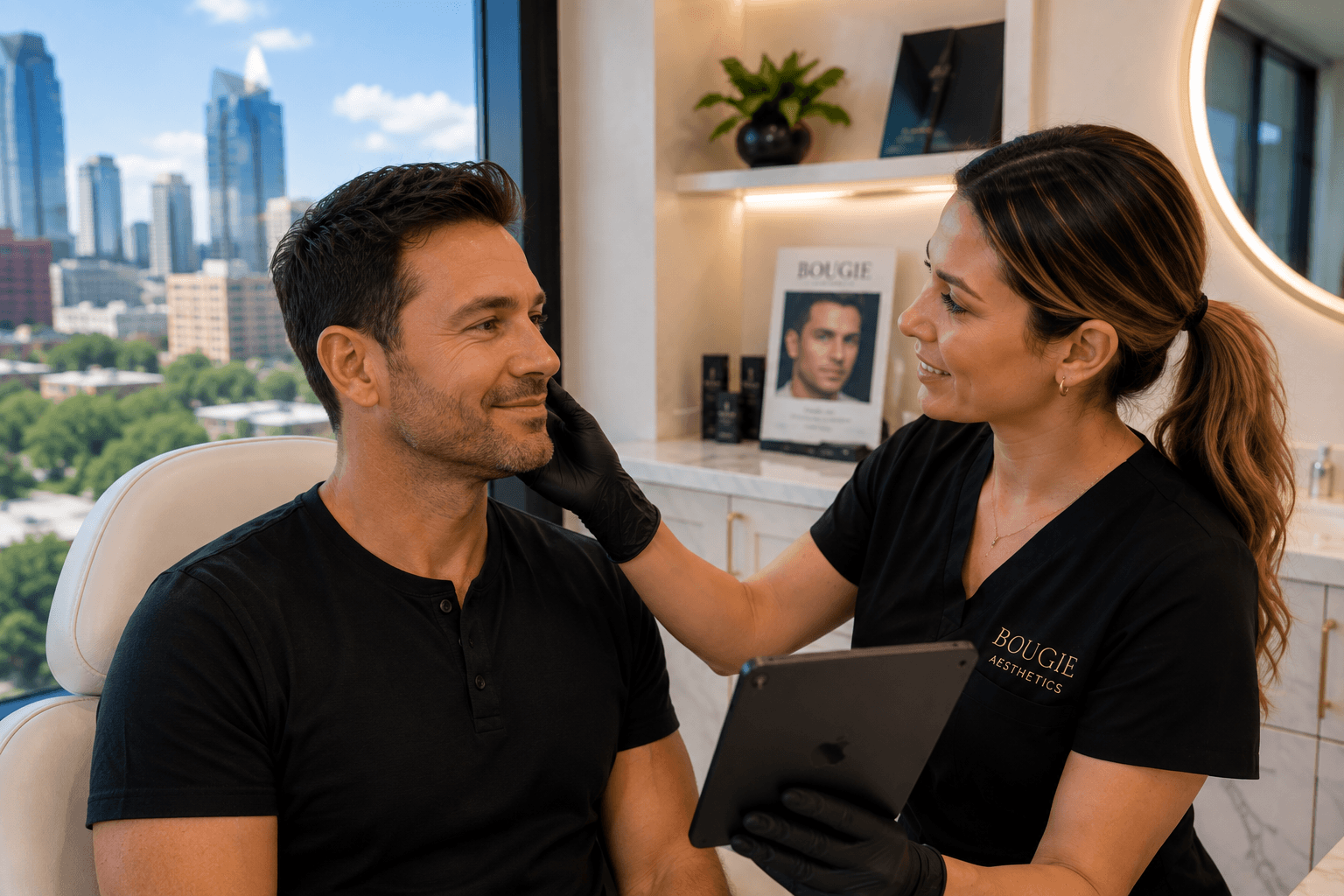
There's still a lingering assumption that cosmetic treatment is something men avoid talking about, even when they're privately curious about it. But that assumption doesn't really hold up anymore. More men are walking into consultations asking direct, practical questions about their hairline, their jaw, or the tired look that's crept into their face over the last few years. Mens aesthetic treatment has quietly become mainstream, and Fort Worth is no exception.
If you've been wondering whether any of this actually applies to you, or whether it's worth bringing up at all, here's an honest look at the concerns men commonly bring in and what's actually available to address them at a clinic like Bougie Aesthetics. Our guide on the top aesthetic treatments for men in Fort Worth is a good companion read alongside this one.
Why Are Men Increasingly Open to Aesthetic Treatment?
A lot of it comes down to practicality. Men are staying in competitive workplaces longer, dating later in life, and generally paying more attention to how they present themselves without necessarily wanting anything dramatic. Most men aren't asking for a different face. They're asking to look like a rested, less stressed version of the one they already have.
Is Mens Aesthetic Treatment Different From What Women Typically Get?
Not fundamentally, but technique and dosing often differ. Male facial anatomy tends to have thicker skin, denser muscle mass, and different bone structure, particularly around the brow and jaw. Providers experienced in treating men, like the team at Bougie Aesthetics, adjust technique accordingly so results look natural rather than feminizing or overdone.
Common Concerns Men Bring to Their First Consultation
Is My Hairline Thinning, or Am I Overreacting?
Hair thinning is one of the most common, and most quietly stressed about, concerns men bring in. Genetics, stress, and hormonal factors can all contribute to early thinning, particularly around the temples and crown. Hair scalp treatment using PRP and PRF has become a legitimate option for men noticing early stage thinning, using their own blood plasma to stimulate follicle activity and support fuller regrowth over time. Our post on restoring a thinning hairline with PRP treatments walks through what that process looks like.
Why Do I Look Tired Even When I've Slept Fine?
This usually points to a combination of volume loss under the eyes, deepening forehead lines, and a heavier brow position, none of which are related to actual sleep quality. Neurotoxins like Botox and Dysport can lift a heavy brow and soften forehead lines, while strategic dermal filler placement can address hollowing under the eyes that contributes to that perpetually tired look.
Is My Jawline Losing Definition as I Get Older?
A jawline contour that used to feel sharp can soften due to volume shifts, fat distribution changes, and mild sagging skin. Filler placed along the jaw and chin, sometimes combined with Kybella to address fullness under the chin, can restore a more defined, structured profile.
What's Going on With the Deep Lines Between My Eyebrows?
The vertical lines between the brows tend to look more pronounced on men due to thicker skin and stronger underlying muscle movement, which can read as an angry or stressed expression even when someone feels perfectly fine. Neurotoxin treatment specifically targeting this area is one of the most requested treatments among male clients for exactly this reason.
Is My Skin Just Rougher Than It Used to Be?
Years of shaving, sun exposure, and, honestly, skipping skincare altogether tend to catch up eventually. Skin repair through chemical peels, microneedling, or the ZO custom facial can noticeably improve texture, reduce visible pores, and even out tone that's taken a beating over the years.
What Can Be Done About a Double Chin That Won't Go Away With Diet or Exercise?
Submental fullness, commonly known as a double chin, is often stubborn fat that doesn't respond to diet or exercise because it's structural rather than related to overall body fat. Kybella is a non surgical injectable specifically designed to gradually break down fat cells in this area over a series of treatments.
What Does "Brotox" Actually Mean, and Is It Different From Regular Botox?
The term gets thrown around casually, but it really just refers to Botox administered with technique adjusted for male facial anatomy. Because men typically have stronger frontalis and glabellar muscles, dosing is often higher than what's used for female clients to achieve a comparable, natural looking result rather than an artificially smooth or frozen appearance. Our post on how Botox for men, or brotox, is administered differently breaks down these differences in more detail.
Will Botox Make Me Look Unnatural or Overly Smooth?
Not when dosed appropriately for male anatomy by an experienced injector. The goal for most male clients is subtle softening, not the complete elimination of expression. A good provider will intentionally leave enough natural movement that nobody notices you've had anything done, they just notice you look a little less tense.
Who Is a Good Candidate for Mens Aesthetic Treatments?
Most healthy adult men noticing early signs of aging, thinning hair, or skin texture concerns are reasonable candidates for these treatments. As with any cosmetic procedure, certain medical conditions and medications can affect eligibility, which is why a straightforward consultation is always the right first step before committing to anything.
What Should I Expect at My First Appointment?
Expect a direct, no nonsense conversation about what's actually bothering you and what's realistically achievable. Most male clients appreciate a straightforward approach without excessive small talk, and a good provider will match that energy while still being thorough about your history and goals.
Why Fort Worth Men Are Prioritizing This Now
Between a competitive local job market and a culture that increasingly normalizes basic self care for men, more clients are treating aesthetic maintenance the same way they'd treat a haircut or a gym membership, as routine upkeep rather than a major life decision. Texas sun exposure also plays a role, accelerating skin texture concerns and volume loss earlier than in less sun heavy regions, which pushes more men to address concerns sooner rather than later.
Yes, It's Fine to Care About This
There's no reason treating your hairline, your jaw, or the tired look on your face should require some elaborate justification. Plenty of men are already doing it quietly, and the ones getting results tend to be the ones who stopped overthinking whether it was allowed and just asked a straightforward question at a consultation. If something about your reflection has been bugging you, that's reason enough to bring it up. You can explore the full men's aesthetic treatment menu, browse real results in the gallery, or book a consultation with Bougie Aesthetics whenever you're ready.
This guide is reviewed and updated regularly by our team, most recently in August 2026, to reflect current treatment approaches for male clients.
Frequently Asked Questions
Do men need different dosing than women for Botox or Dysport? Yes, men typically require higher doses due to stronger facial muscles, particularly in the forehead and between the brows, to achieve a comparable, natural looking result.
Is PRP hair restoration effective for men with early thinning? Many men see improved hair density and reduced shedding with a series of PRP or PRF treatments, particularly when started in earlier stages of thinning rather than after significant hair loss has already occurred.
Will people be able to tell I've had treatment done? When performed by an experienced provider with technique suited to male anatomy, most treatments produce subtle, natural looking results that read as simply looking rested rather than visibly treated.
What's the most common first treatment for men? Botox or Dysport for forehead lines and the area between the brows tends to be the most common entry point, often alongside interest in jawline filler or Kybella for a double chin.
Is there an age men should start considering these treatments? There's no universal starting age. Some men begin in their late twenties or early thirties to address early concerns preventatively, while others wait until their forties or later. It really depends on individual concerns and goals.